Embodied Grief: A new series of grief dolls.
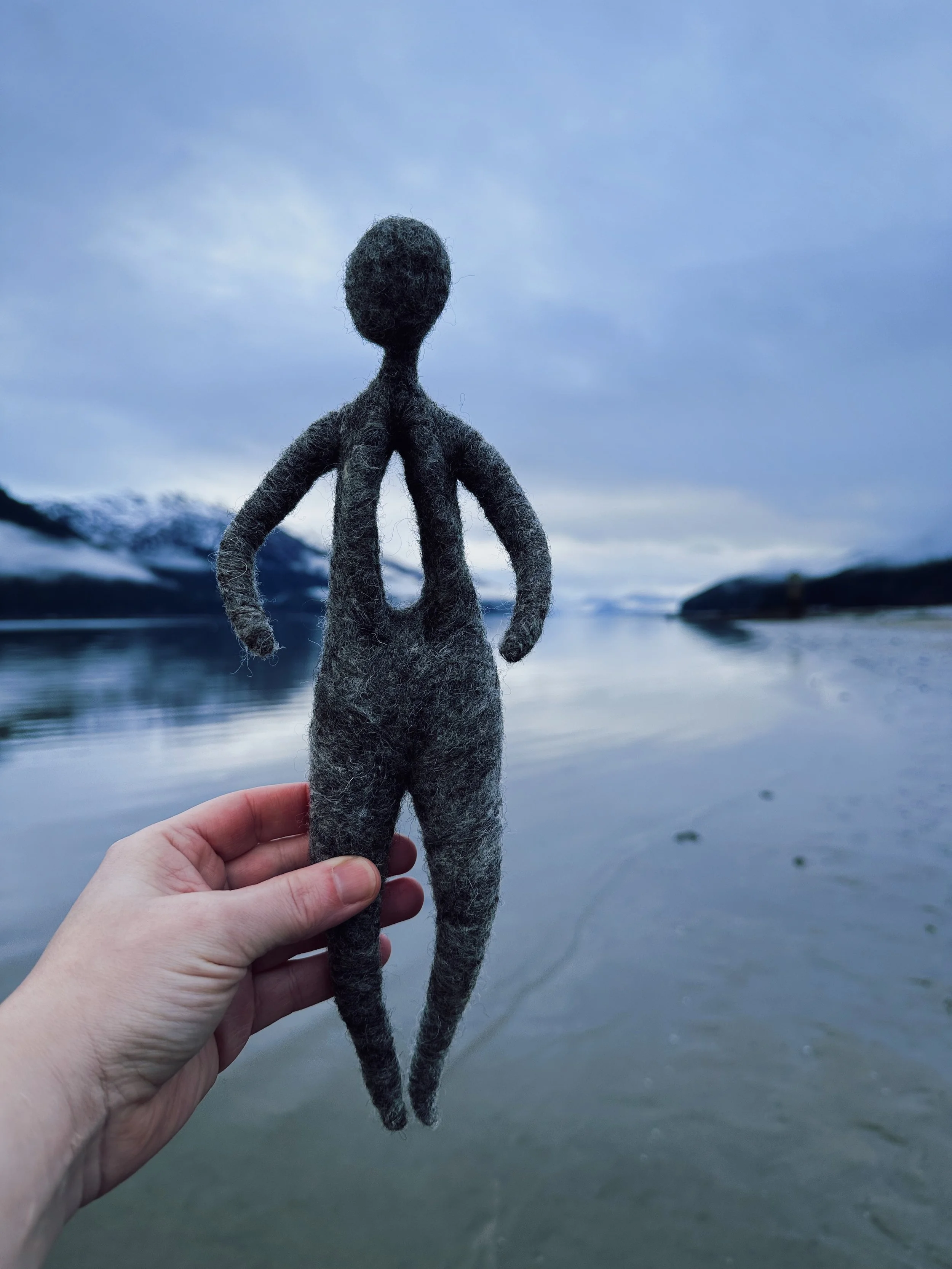
A different kind of grief doll.
I recently started a new series of dolls exploring embodied grief.
A little bit of background:
A year or so ago, while reading Returning Home to Our Bodies by Abigail Rose Clarke (a lovely book, especially if you’re looking for embodiment practices that tune into the self while also engaging our connection to the world around us), I began to think about the word “embodiment” and what it really means in practice.
Embodiment has become a bit of a buzz word, it seems. So many people encourage us to be in our bodies, to tune in with our physical sensations, in order to be truly awake to life and to our experiences. But how do we practice embodiment when our bodies have known trauma? For those of us who fall into this group (which is so many of us) full embodiment can be overwhelming or even painful. Books like The Body Keeps the Score and My Grandmother’s Hands address how trauma is held in the body - and how those traumas are passed through the generations.
My own experience of embodiment has changed over the years. Presence and being fully IN my body is something that I’ve struggled with for as long as I can remember. As someone who experienced childhood physical, sexual, and emotional abuse, it’s easy for me to slip into dissociation. I’ve gotten better at tuning into my body in the present moment, but there was a time when I was so disconnected from my body that I didn’t recognize things like hunger cues or other types of physical discomfort.
One practice that’s helped me create a greater sense of presence and embodiment is to ask myself questions in those moments when I’d rather check out from whatever my body is experiencing. What am I turning away from in those moments? What would nourish me and enable to me to stay with what I’m feeling, to give it space to exist, rather than trying to smash it back down inside?
I’ve spent a lot of time in those contemplations, noticing, gently observing. What keeps me from being fully present in my body? What feelings come up (whether physical or emotional) when I sit in stillness, focus on my breathing, and take the time to really connect with - and listen to - my body? And what does it mean to lean into this awareness even in difficult moments?
Through my own contemplations and by creating a regular (slow and compassionate) embodiment practice, I’ve discovered that so much of what I’ve been running away from in those moments of dissociation isn’t the trauma itself. What I’m running from is grief. This grief has so many faces. It’s grief from loss, childhood lack of safety, abandonment, heartbreak of all kinds, environmental grief, and collective grief.
Grief, it turns out, is deeply woven into my personal embodiment practice.
Grief is a feeling, but it’s also held within our viscera. Opening to grief is painful and our instinct is often to turn away from it. But what if we turned toward it? What does it mean to embody our grief?
For me, embodying my grief begins with acknowledging it and not over-identifying with it. I’ve learned that I need to find a way to hold the grief, give it space to exist, and not be taken over by it. Feeling what’s here without becoming grief. Greeting my grief as a welcome visitor and allowing myself to be broken open. Letting my grief flow up and out, bringing tears and sometimes howls of rage. There have been times when I thought my grief would swallow me whole. For so many years, I felt “other” because of my grief - but I see now how big of a role my own experience of grief and loss has played in the uncovering of my gifts. The practice of connecting with it has changed the way that I understand myself and allowed my gifts to emerge.
A new kind of grief doll
As a doll-maker, I found myself drawn to creating a doll to externalize what I feel in those moments of deep, overwhelming grief. I want to create dolls that accurately represent these feelings - both the pain from the wounding and the strength that comes when we allow the pain to move through us and transform us.
This new doll series is my response to the question, “What does embodied grief look like?”
Some questions I’m contemplating as I create these dolls:
What does it mean to embody our grief? What does grief FEEL like? How does grief transform us? How do we shapeshift around our grief - and who do we become when we allow ourselves to be transformed by it? What does it mean to open to grief - to allow it to change you - without being swallowed by it?
Or perhaps we are, for a time, swallowed whole, digested, and then rebirthed as something new, changed in ways we can’t even imagine.
A doll to externalize the emptiness I feel in moments of deep grief.
I remember a meeting I once had with the counselor at the boarding school I attended during my freshman year of high school. He had asked me to try and explain how I was feeling - the deep depression I was working through. I told him that I wished I could take a knife and carve a hole out in the middle of my chest - I gestured toward my solar plexus - and explained that I wanted to show people the pain that I felt inside. I spent a lot of time trying to externalize that pain, without understanding that it was grief, often mixed with fear and distrust - and that in order to get to the other side of it, I needed to allow myself to feel it.
The first doll in this series is one that externalizes those feelings, and will eventually show the process of healing and the gifts I’ve discovered hidden inside my grief. The story of these dolls is told in the making, and so I’ll be sharing more about the process itself - how the grief is woven into the doll and how the healing emerges. She holds Hawthorn berries in her womb space, for heart healing. May the spirit of Hawthorn help to knit her back together.
This is a new kind of grief doll - and a big change from the dolls I’ve made in the past. I’m excited to see where this series goes and I hope you’ll follow along.
~geraldine